Posts

Showing posts with the label LED Bulb

Home Lighting – Basic Lights
Image
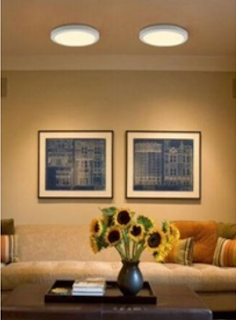
We have our dining room, living room, work office, kitchen, bedroom, etc. and we know that different rooms serve different purposes. Hence each room, having a purpose or multiple purposes requires a suited lighting solution.  Lighting features need to perfectly correspond to the purpose, setting, and application of the room.  Lighting at home is designed to illuminate various interior spaces as per the functional and aesthetic requirements. Lighting the interior spaces include planning the layout of lights, selection of different light fixtures and the type of lights. For home interior design, the lighting system is designed as a layered system. Interior spaces are illuminated using combination of different type of lights & each light has its own distinctive feature. The home lighting is a science as well as art. The science is based on fundamental load design, whereas, the element of art provides ...
Energy Conservation and LED Lights

Image
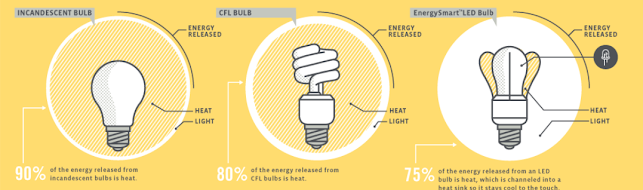
Lighting represents almost 20% of global electricity consumption. With the emerging concept of retrofitting, it is desirable to spare as many kilowatts of power as possible. This not only results in better utilization of energy inside buildings but also helps us to cut our electricity bill.  It is quite feasible and economically viable by just making few changes inside our buildings or homes, for instance, changing paint color of the walls, choosing windows that prevent unnecessary heat transfer and even the simplest trick is to use LED light bulbs of suitable illuminance and wattage instead of traditional light bulbs. Light Emitting Diodes (LEDs) are extremely energy-efficient. Nowadays LEDs are used for household light  fixtures due to following reasons: 1)  Cost-Saving &  Energy Efficiency  The number one benefit of LEDs is their energy efficiency.  In comparison to incandescent, halogen or fluorescent (CFL) lamps with LED lighting, we can expect e...

Life of LED Light

Image
LEDs are sustainable, eco-friendly, efficient, and safe lighting solutions that deliver multiple benefits to the users.   One of the benefits of LED is its long lifetime. Because they have no movable parts  or filaments tht may break, LED’s can have long lifetime. LEDs generally do not fail by burning out but will slowly reduce in light output over time; as solid state devices they will continue to operate even after 100,000 hours, continuing to use electrical power even if they produce very little useful light. LEDs, however, follow a different method for measuring life expectancy called lumen maintenance. What is lumen maintenance? Lumen maintenance is an approach of measuring the light output (lumens) of a brand new light source and comparing that with its light output after a certain period of time. L70 and L50 are examples of lumen maintenance – benchmarks for when 70% or 50% of a lamp or fixture's total light output remains. What is L70? It is rated lumen-maint...

DOB LED Lights

Image
A DOB "driver-on-board" LED light is an LED lighting system (either an LED bulb or an LED luminaire) that incorporates a light engine (driver-integrated LED assembly intended to operate directly on line voltage power) with an integrated on-board driver.  In conventional LED lighting systems the driver is typically separated from the LED assembly and fabricated on an FR4 printed circuit board (PCB). This configuration is based on the consideration that LED drivers have been dominantly designed as switching mode power supplies. SMPS drivers typically make use of bulky, expensive and unreliable reactive components such as inductors and capacitors. The use of reactive components necessitates a dedicated FR4 board which provide adequate routing layers for component interconnects. In an integrated lighting system, the considerable volume of a typical SMPS driver creates a need for an adequate space within the lighting system in order to accomm...

LED Bulb - Structure & Types

Image
LED light bulb  produces light using light-emitting diodes (LEDs). LED lamps are significantly more energy-efficient than equivalent incandescent lamps and can be significantly more efficient than most fluorescent lamps.                          We can put LED bulbs in regular lighting fixtures.  This includes fixtures that have previously used incandescent bulbs or CFL bulbs. After all, LED light bulbs are intended to replace old light bulb designs that are less energy efficient. Be sure to choose an LED bulb with a base, shape, and wattage that is compatible with the fixture. As LED bulbs are being manufactured in every possible design, it should easy to find the right fit for your lamp or chandelier. There are 2 types of LED Bulbs Driver LED bulb In these types of Bulb, a separate driver circuit is used for power supply. LEDs are mounted on separate chipset. DOB ( Direct On Board...